Analysis 5 min read
Our first information day on Swiss franc mortgages, in Ferney‑Voltaire.
On 28 October, in Ferney‑Voltaire, the lawyers at ACTIVE AVOCATS and Hello Justice presented the claims arising from Swiss franc mortgages.
Hello Justice, editorial team

Contents
On Wednesday 28 October 2026, we held our first information day on Swiss franc mortgages in Ferney‑Voltaire. We organised it with ACTIVE AVOCATS, a firm of the COGEP AVOCATS group, at the Appart’City Collection Genève Aéroport. Maître Vincent DURAND, a partner at the firm, and Valentin PETITCLERC, President and founder of Hello Justice, presented, with the firm’s lawyers, the claims these loans give rise to and how the proceedings are funded.
The day of 28 October.
The 45-minute talks followed one another from midday to the evening: 30 minutes of presentation, then 15 minutes of questions. Between two talks, the firm’s lawyers met borrowers in 15-minute one‑to‑one meetings to go through their loan and its documents with them. The talks and the one‑to‑one meetings were free, on registration.

A lawyer at ACTIVE AVOCATS meets a borrower on 28 October.
Thank you to everyone who came to meet us in Ferney‑Voltaire.
The franc since the loans were signed.
The talk opens with the curve of the euro in Swiss francs since 2000, at the reference rates of the European Central Bank Source [1]. For a loan signed in October 2007, each franc repaid cost 80% more in euros on 16 October 2026 than at signature Source [1]. Borrowers repay in euros instalments set in francs, and bear this extra cost at every instalment.
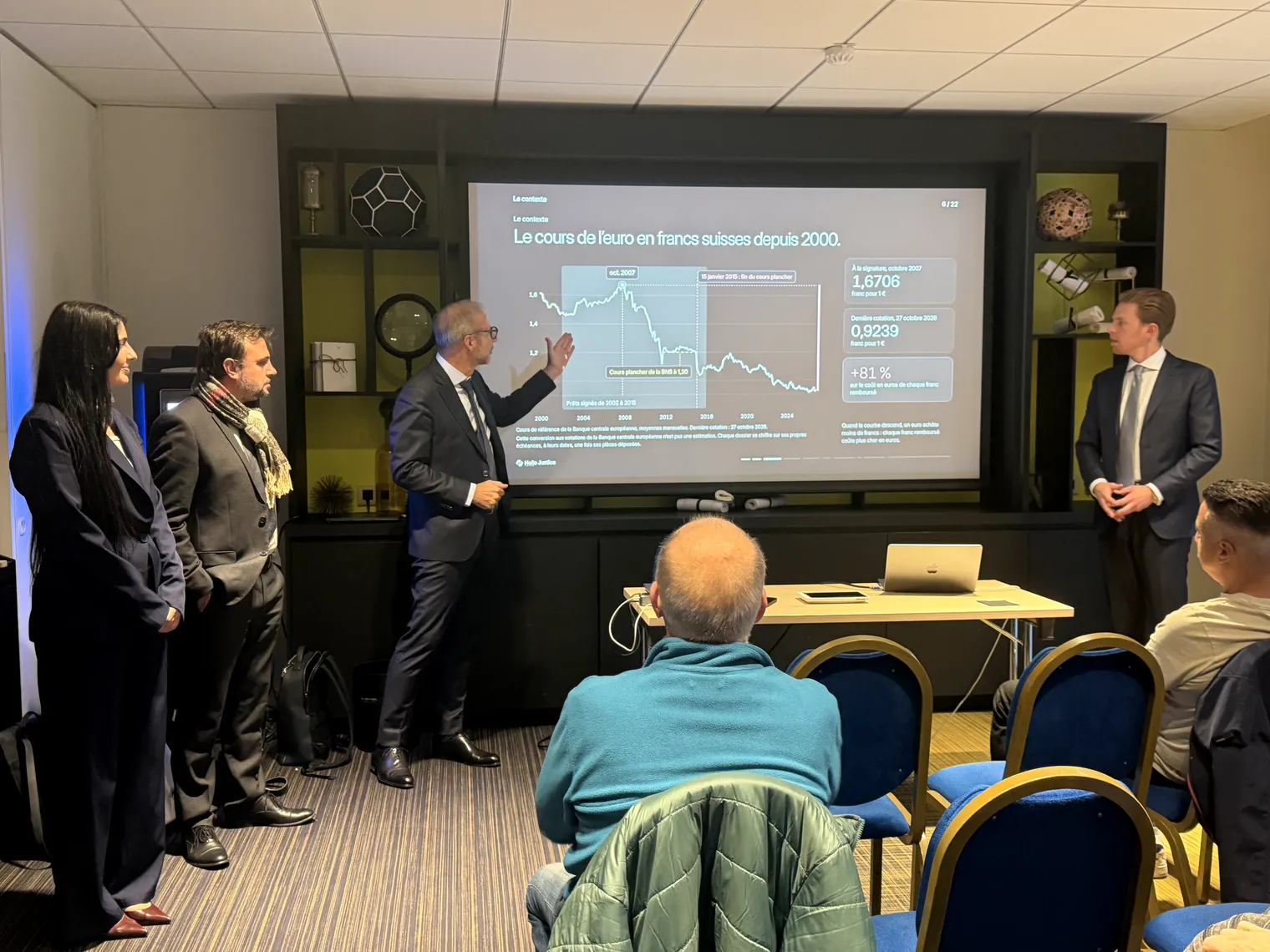
Maître Vincent DURAND, a partner at ACTIVE AVOCATS, presents the euro against the Swiss franc since 2000, with the firm’s lawyers and Valentin PETITCLERC, President of Hello Justice.
The rulings of 9 July 2025.
The lawyers then presented the two rulings handed down by the Cour de cassation on 9 July 2025 Source [2]. One holds that the currency risk is assessed over the whole term of the loan: a borrower paid in Swiss francs remains exposed to it when the property financed is in France, and the protection against unfair terms is open to them. The other upholds the clause of a bank that had clearly informed its customer. This is recent case law, liable to change, and the transparency of the contract is judged on the documents provided at signature, case by case.
Time limits for bringing a claim.
Proceedings against a Swiss franc loan can involve three claims, and each follows its own reasoning. A claim to have a term declared unfair is not time‑barred Source [3] Source [4]. Restitution of the sums paid must be claimed within five years of, in principle, the decision that finds the clause unfair Source [5]. The bank may, however, show that the borrower knew, or could reasonably have known, of the unfairness before that decision Source [6]: this is recent case law, liable to change. A claim against the bank for failing to inform the borrower is time‑barred after five years, from actual knowledge of the failure and its possible consequences Source [7]. The admissibility of a claim says nothing about its success on the merits or the amount recoverable. Our article on the time limit for bringing a claim sets out these rules.
Quantifying a claim.
A clause held to be unfair is deemed unwritten: the loan is recalculated in euros, or the agreement is annulled. No overall refund is automatic, and each claim must be proved. The lawyers presented the documents needed to qualify a case: the loan offer, with its schedules and the notices provided at signature, any amendments, the amortisation tables and, if the loan has been repaid, the redemption statement. The firm’s preliminary analysis does not predict the outcome: no single factor is decisive.
On screen, the Hello Justice algorithm quantified a fictitious loan of 200,000 francs, instalment by instalment. It converts each instalment at the official European Central Bank rate for the day it is debited. The firm relies on this calculation to quantify your claim.
Funding the proceedings.
Valentin PETITCLERC presented how the programme is funded. The principle of litigation funding: Hello Justice covers 100% of your lawyer’s fees and is paid out of the sums recovered, only if the case succeeds.
- Checking your case: free. Submitting your case is free and commits you to nothing.
- Your lawyer’s fees: 100% covered. Whatever the amount you borrowed, at first instance as on appeal.
- Your out‑of‑pocket costs: €300. Paid when your case is opened, if it is accepted, to bring proceedings against your bank. If there is an appeal, only the €225 appeal duty is added.
- If the case succeeds: 14% incl. VAT. On the sums recovered and the saving obtained on your loan. If the case fails, you repay nothing to Hello Justice.
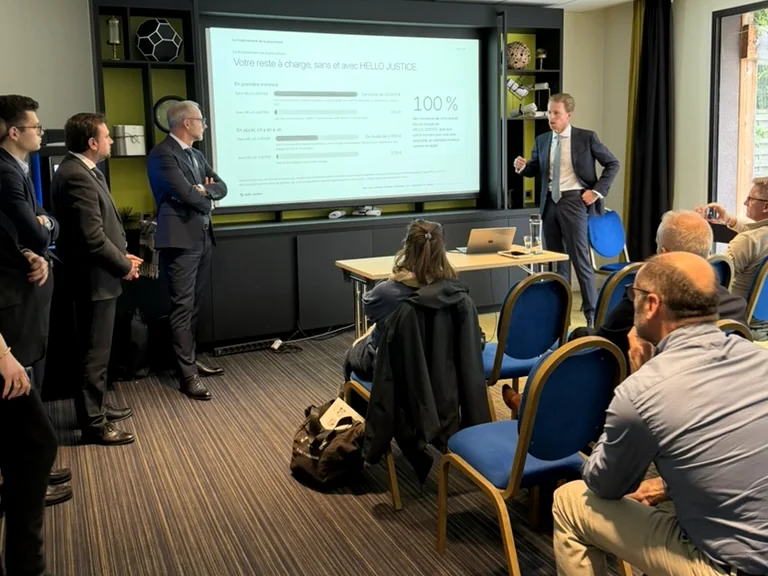
Valentin PETITCLERC, President of Hello Justice, presents the out‑of‑pocket costs of proceedings, without and with our funding, at first instance and on appeal.
The next information days.
Three information days follow: Tuesday 3 November in Ferney‑Voltaire, at the Appart’City Collection Genève Aéroport, then Wednesday 18 and Tuesday 24 November in Annecy, at the Hôtel Moxy Annecy. The talks and the one‑to‑one meetings are free, on registration: choose your city and date on the information days page.
Can’t make it? Submit your case online from your phone: you can add a missing document later, from your personal space.
Sources
- 1.European Central Bank, euro reference exchange rates, EUR/CHF series (EXR.D.CHF.EUR.SP00.A), monthly averages for October 2007 and the rate of 16 October 2026 (new tab) Back to reference 1 in the text
- 2.Cour de cassation, First Civil Chamber, 9 July 2025, no. 24-19.647 and no. 24-18.018, published, recent case law, liable to change (new tab) Back to reference 2 in the text
- 3.Court of Justice of the European Union, 10 June 2021, C-776/19 to C-782/19 (new tab) Back to reference 3 in the text
- 4.Cour de cassation, First Civil Chamber, 30 March 2022, no. 19-17.996, published (new tab) Back to reference 4 in the text
- 5.Cour de cassation, First Civil Chamber, 12 July 2023, no. 22-17.030, published (new tab) Back to reference 5 in the text
- 6.Cour de cassation, First Civil Chamber, 17 September 2025, no. 23-23.629, published (new tab)
- 7.French Civil Code, article 2224 (new tab) Back to reference 7 in the text